Thyroid eye disease
Treat eyelid changes caused by thyroid eye disease to protect your eyes and recover your normal eyelid shape
What is Thyroid Eye Disease?
Thyroid eye disease, also known as TED (thyroid eye disease) or Graves’ orbitopathy, is a condition associated with hyperthyroidism that causes inflammation of the tissues surrounding the eyes. One of its main symptoms is exophthalmos (bulging eyes), caused by an increase in soft tissue, thickened extraocular muscles, and an expansion of orbital fat that pushes the eye forward.
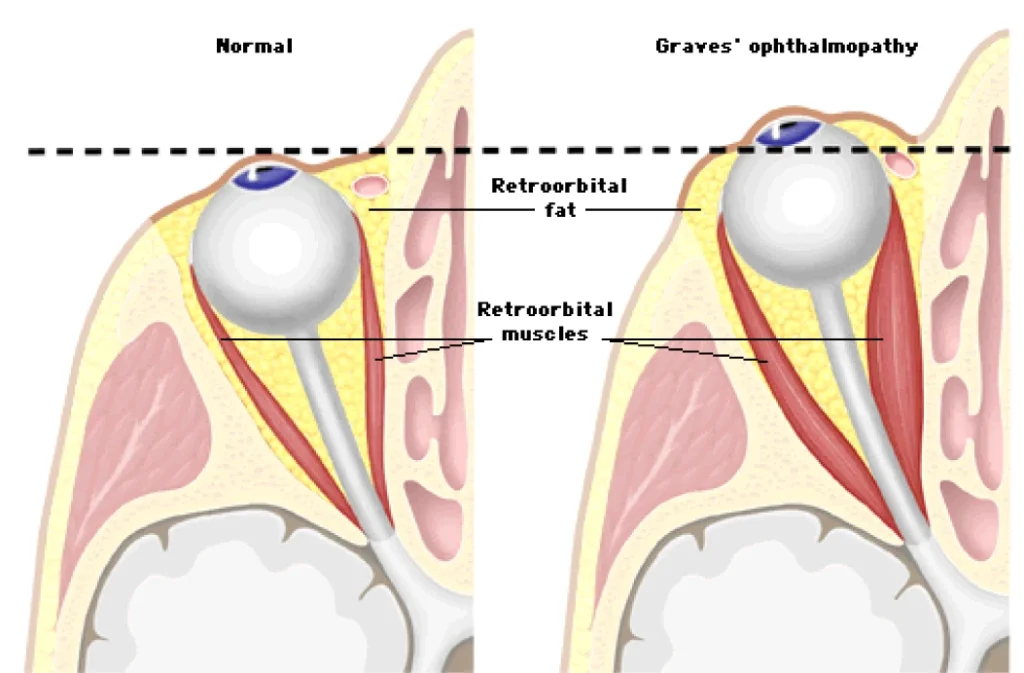
Common symptoms of Thyroid Eye Disease
- Bulging eyes (exophthalmos)
- Scleral exposure (visible white part of the eye above the iris)
- Redness, irritation, and a foreign body sensation
- Double vision (diplopia)
- Swelling and redness of the eyes
- Rapid enlargement of eyelid bags due to increased orbital fat
Treatments for Thyroid Eye Disease
To relieve both functional and aesthetic problems, several medical and surgical procedures are available. The most common include:
- Orbital Decompression:
This treatment allows the eyes to move back by removing bone and fat from the orbit, creating more space and restoring a more natural anatomical position. - Strabismus Surgery:
In some cases, eye misalignment (strabismus) occurs due to enlargement of the extra-ocular muscles. This surgery adjusts the muscles to realign the eyes and correct double vision (diplopia). - Upper Eyelid Lowering Procedures:
To treat upper eyelid retraction, a procedure can be performed to partially release the levator muscle, allowing the eyelid to descend to a more natural position. - Lower Eyelid Augmentation:
In cases of prominent eyes, the lower eyelid can be repositioned using surgical techniques such as canthoplasty or tarsorrhaphy, improving both the appearance and function of the lower eyelid.
More Information
Thyroid eye disease requires an accurate diagnosis and an individualised approach for each patient. If you are experiencing related symptoms, it is important to consult a specialist to develop the appropriate treatment plan and improve ocular function as early as possible.
Contact us
Take the next step toward your well-being,
with expert guidance at every stage.